What a CNFans order costs, part by part
The bill for an agent order arrives in pieces. This page names each piece, says who sets it and when you pay it, and shows the currency arithmetic from one real catalog card.
A CNFans bill, taken apart
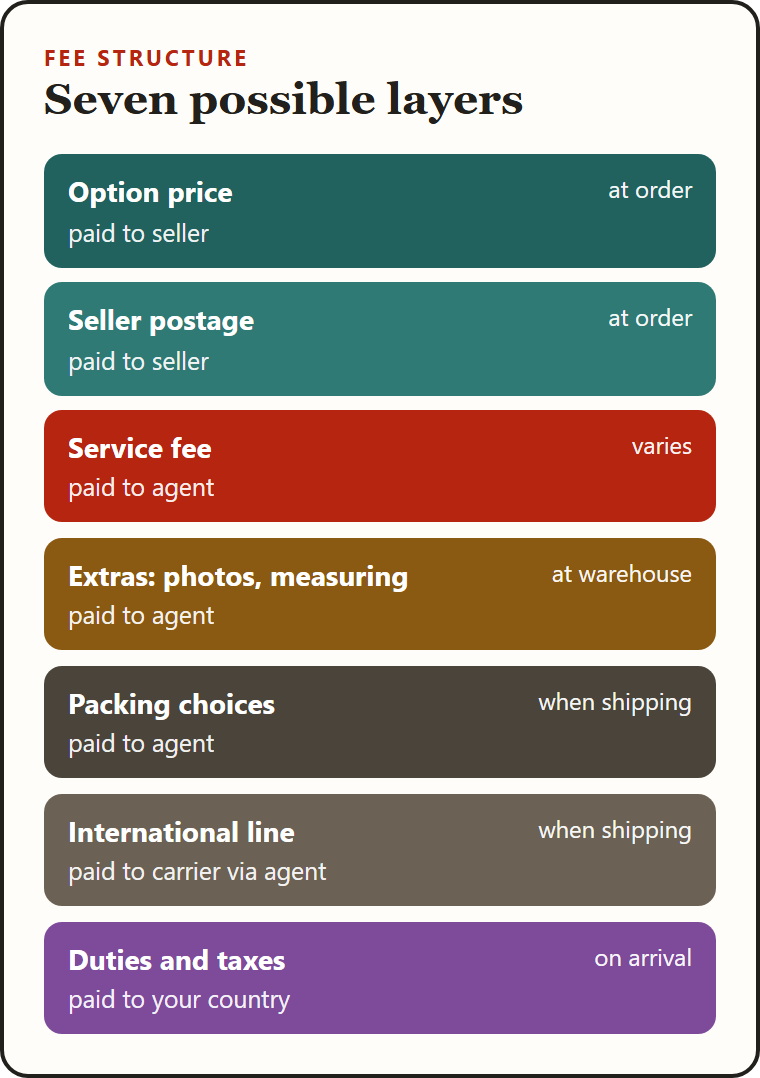
The fee structure of an agent order is easier to follow once you see that it is several small bills paid at different times, not one price. Some parts are set by the seller, some by the agent, some by the carrier and one, possibly, by your own country.
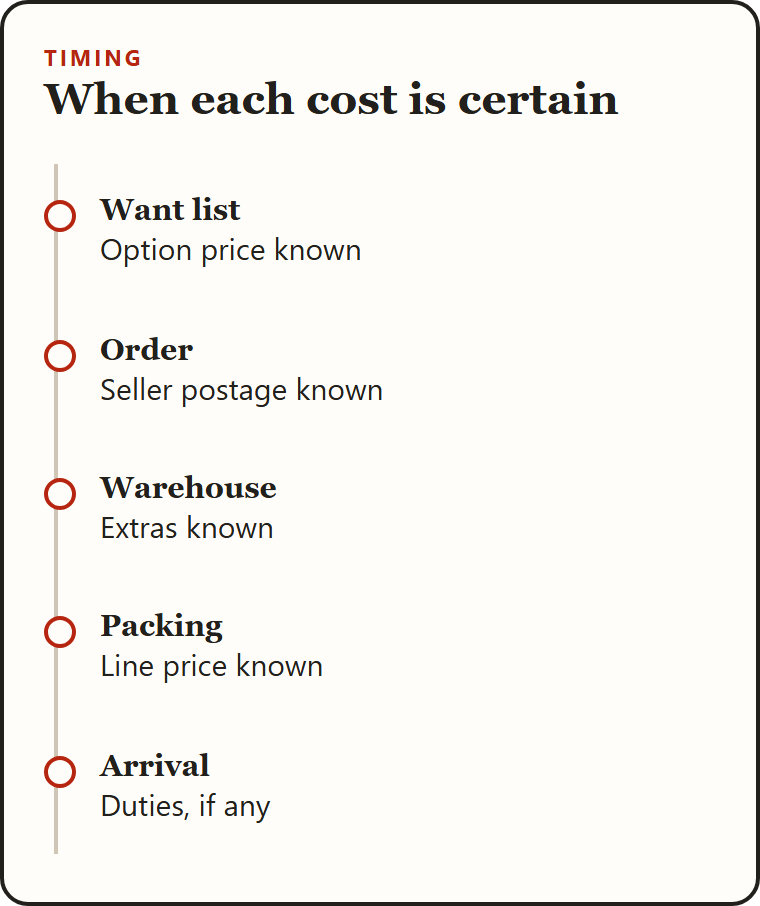
Paid at the order: the item price for your option and the seller’s postage to the warehouse. Paid while the item waits: any extras you ask for, such as more photos or a measurement. Paid when you ship: the international line, priced on the packed parcel. Paid on arrival, if at all: duties and taxes.
A service fee for the agent’s work may be added at one or more of those points; how CNFans charges it is something the archived pages did not show, as explained below. Write each part down on your want list as you learn it, and the total stops being a surprise.
Not every order has all seven layers. A single T-shirt with free seller postage and no extras has four. A parcel of six finds with special packing and an insured line can have all seven, and the later layers then outweigh the earlier ones.
Item price and the cheapest-option trap
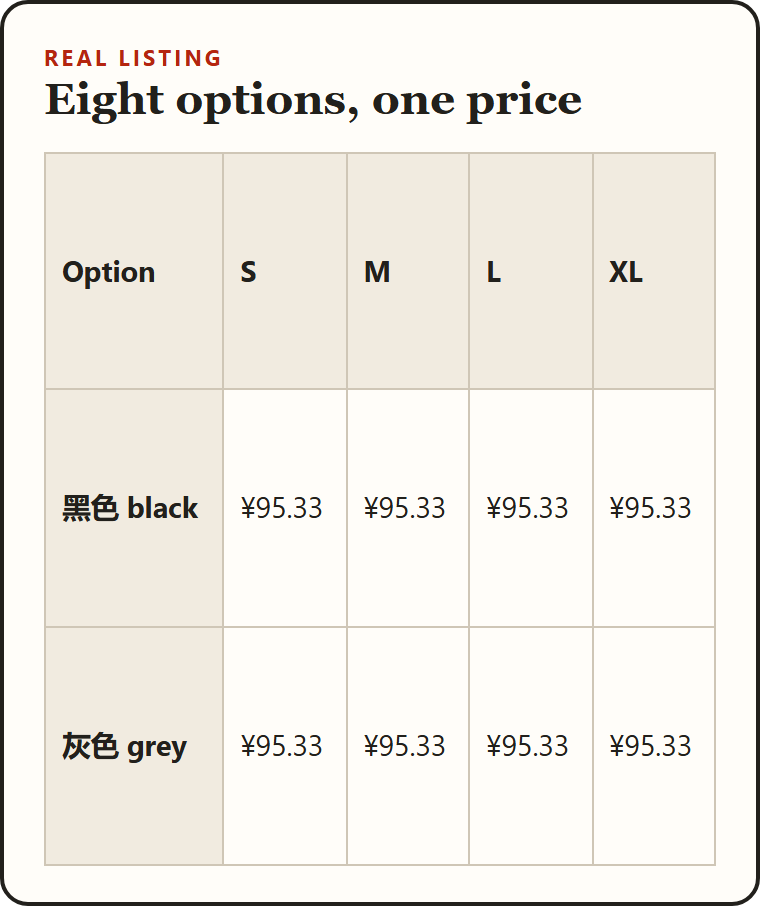
A catalog card quotes the cheapest option on the listing. Sellers often charge more for a larger size, a particular colour or a set, and the card cannot show every combination. If you plan around the card price, a want list of ten finds can come out noticeably higher at checkout.
The fix is the fourth known on the want list: pick your option on the listing and write down the price it shows. On the track pants we checked on 20 October 2026 all eight combinations cost the same ¥95.33, so the card price was the real price. That is common for simple items and rare for anything with sets, lengths or printed extras.
Write the price in yuan. Converting early hides small differences behind rounding and makes it harder to compare with what the agent later charges.
Seller postage inside China
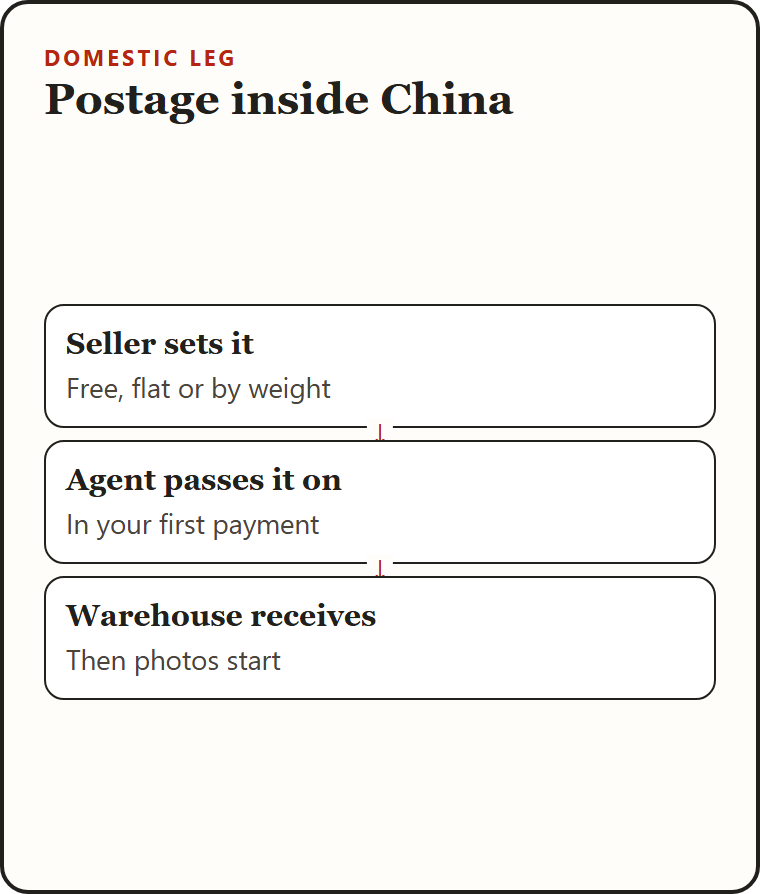
Sellers charge their own postage to the agent’s warehouse, set by the seller, not by the agent. Some include it, some charge a flat amount, and some vary it by weight or by the destination province. The agent folds the charge into your first payment, and next to the international line this domestic shipping fee is usually minor.
Two habits help. If you buy several pieces from one seller, ask whether postage is charged once or per item. And look at where the seller ships from if the listing shows it, because a distant province can add a day or two before the item reaches the warehouse.
The catalog product page we read showed no domestic postage line at all, so the first place you are likely to see the figure is the agent’s order summary. Check it there before you confirm payment.
Service charges and extras: ask prices before services
The archived CNFans footer listed a help topic named “Service & Fees”, but the article text was not captured, and no page we could read printed a fee figure. So this site states no CNFans service fee at all. Treat any number you see quoted elsewhere without a date and a source as unverified.
Extras are the other agent charges: additional photos, measurements, special packing, insurance and the like. They are usually small one by one and add up across a parcel. Ask for the price before you ask for the service.
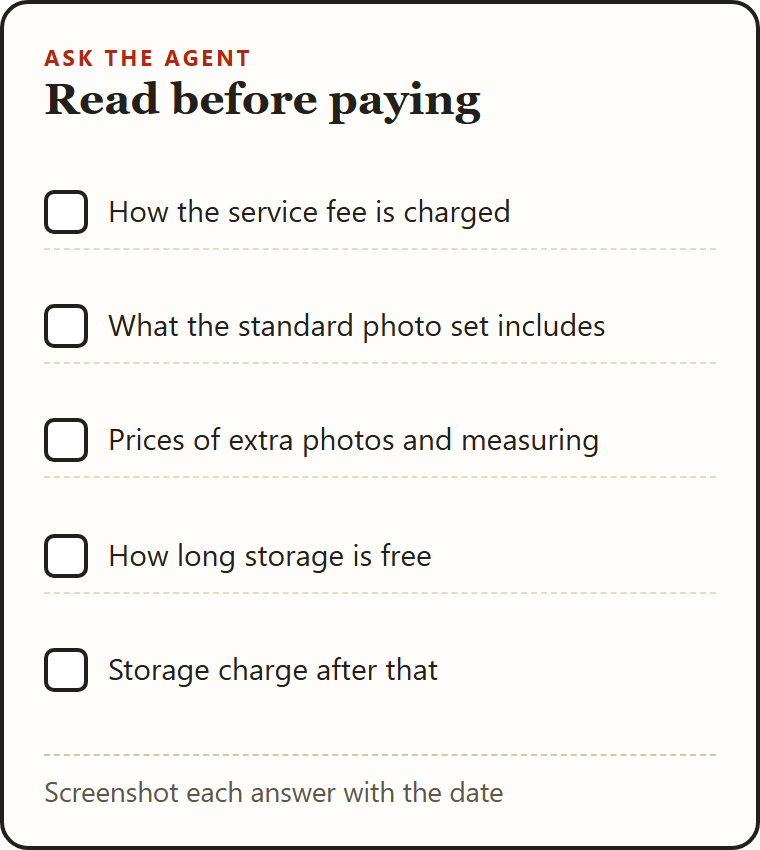
Before paying anything, read these in your account: how the service fee is charged, what the standard photo set includes, how much extras cost, how many days of storage come free and what the days after that cost. Screenshot them with the date.
From yuan to dollars: three rates that can differ
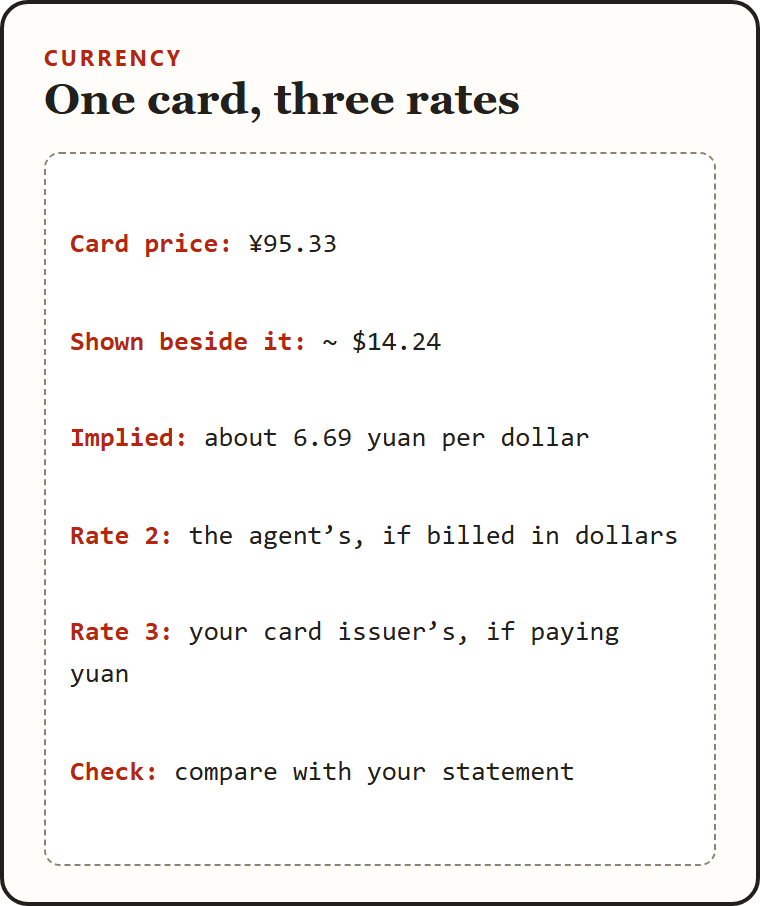
Catalog prices are in yuan. On 20 October 2026 the track pants card read ¥95.33 with “~ $14.24” beside it, which works out at about 6.69 yuan to the dollar. That approximate figure is the catalog’s estimate for browsing, not a quote from anyone who will take your money.
Two other rates decide what you actually pay. If the agent bills you in your own currency, it converts yuan at its own exchange rate, which may include a margin. If you pay in yuan or top up a yuan balance, your card issuer converts instead, sometimes with a foreign transaction fee on top.
You cannot control those rates, but you can compare them. Note the rate shown when you top up or pay, and check your card statement afterwards. After one order you will know roughly how far your real rate sits from the catalog’s estimate.
International shipping and duties come later
The international line is usually the largest single charge after the goods, and it cannot be known exactly until the parcel is packed and weighed. Its price depends on weight, size, the line you choose and the destination. The shipping page explains how those interact.
Duties and taxes are separate again: your own country’s rules create them, the carrier or the post collects them, and the goods and their value decide the amount. They are not an agent fee, and no agent can waive them.
For a want list, the practical rule is to budget the goods first and leave a cushion for shipping. The product page weight boxes in the catalog give an idea of size: the one we read said 502 g for the track pants, a median taken from 23 similar listings rather than a weighing.