Picking well: listing first, seller second, size third
Most disappointments start at the listing. This page reads one real listing closely and turns what it shows into checks you can run on any find before CNFans buys it.
Reading a listing from top to bottom
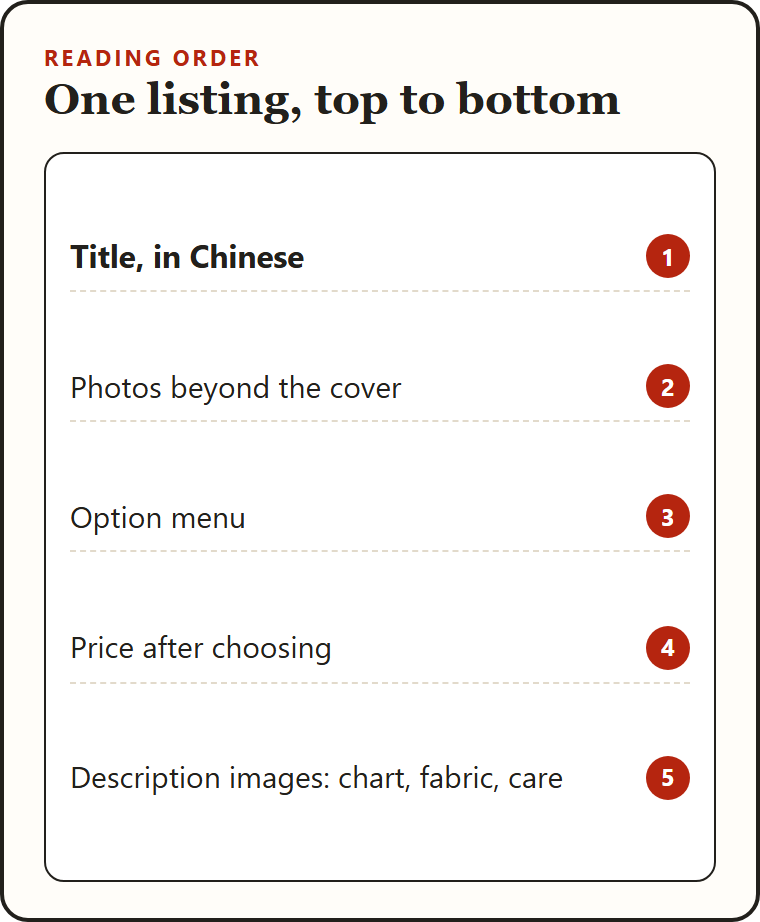
Deciding what to buy starts with the listing itself, read top to bottom, before the price. Here is how to choose an item from a seller page rather than from a cover photo.
Top of the page: the title and the photos. Read the title in Chinese if you can, with a translator if you cannot; the next section explains why. Look past the cover for flat photos, close-ups and anything with a ruler or tape in it.
Middle: the option menu and the price. Pick each option you are considering and watch whether the price changes. Bottom: the description, which on many Chinese listings is a long column of images containing the size chart, the fabric line and care notes. That column is where most of the useful facts live.
If a listing has only a model photo and no chart, it is not necessarily bad, but it cannot become ready on the want list until you have asked for measurements.
Seller titles out-talk catalog titles
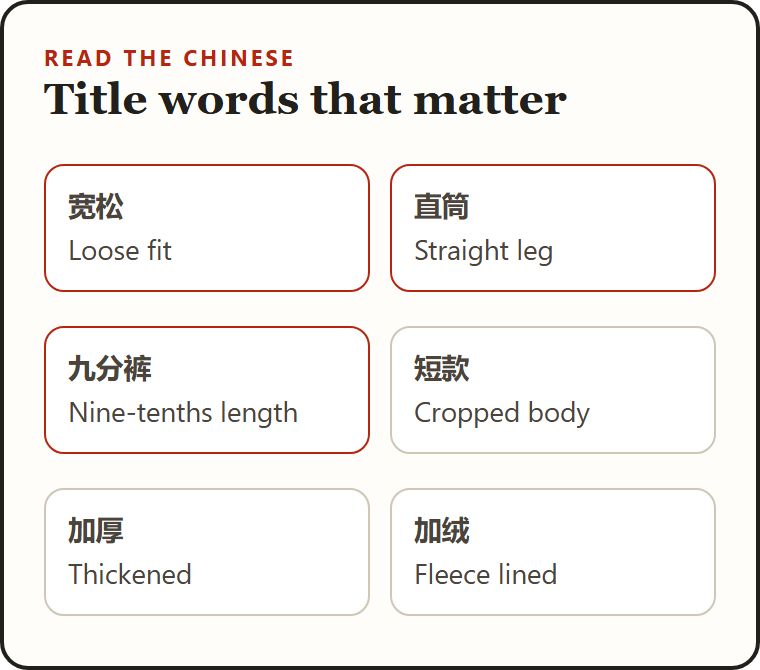
Catalog titles are short English rewrites. Seller titles are long strings of Chinese search words, and they often contain the detail that decides whether the piece suits you.
The track pants we checked on 20 October 2026 are a good example. The card said “Gray and Black Track Pants with Side Stripes”. The seller’s title included 宽松 (loose), 直筒 (straight leg) and 九分裤 (nine-tenths length, so the hem sits above the ankle). Nothing in the English title hinted at the cropped length.
No Chinese is required for this. Paste the seller title into a translator and look for words about fit, length, fabric and season. Our glossary lists the ones that turn up most on clothing.
Option menus and what each option costs
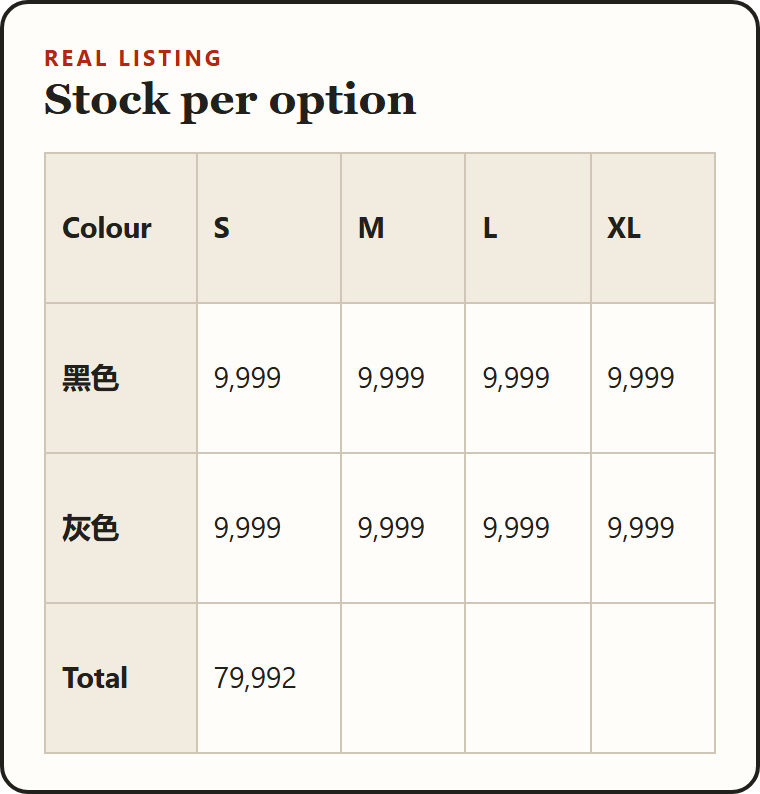
An option menu multiplies choices: colour by size, sometimes by a set or a length. The track pants had two colours and four sizes, eight combinations in all. The seller’s menu, which can be read without logging in, listed every combination at ¥95.33.
Each combination also had its own stock figure, and every one read 9,999. Add the eight together and you get 79,992, which is exactly the figure the catalog page printed before it finished loading. A round number repeated across every option tells you how the seller filled in the form, not how many pairs exist.
So treat stock figures as “not sold out” rather than as counts. And pick every option you are considering, because on listings where prices differ, the card shows only the cheapest.
Centimetre charts against your own clothes
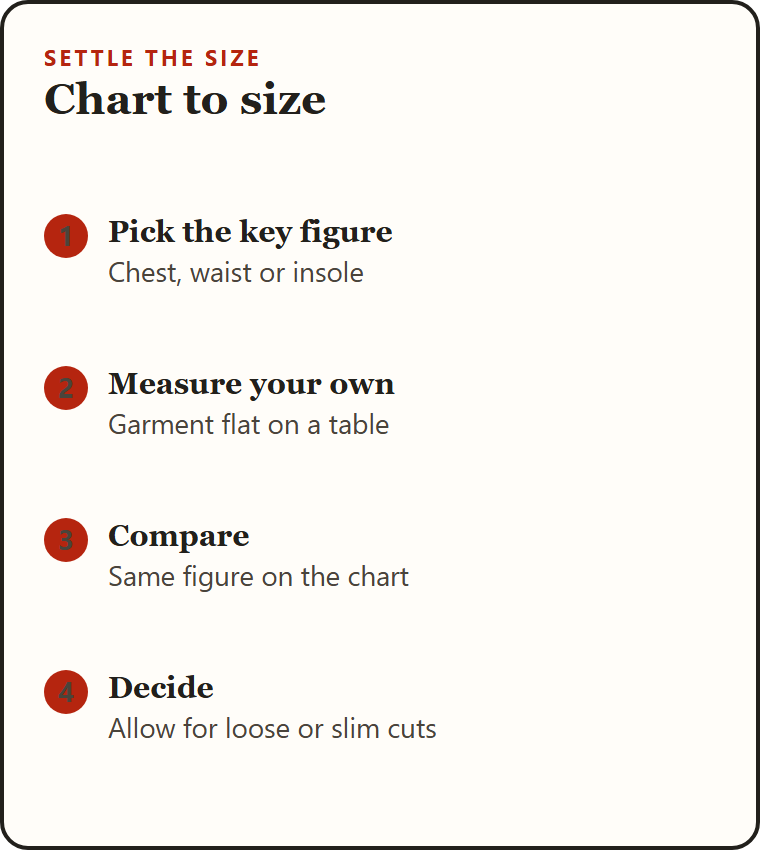
Chinese letter sizes run smaller than many Western ones, but that rule of thumb is not good enough to order by. Use the chart. Decide which figure decides fit for this item, then take the same figure off a garment of yours whose fit already suits you.
Lay that garment flat and run the tape straight across, armpit to armpit for chest, edge to edge for waist. Many charts are written as flat measurements, though some label a flat width as if it were a circumference; comparing with your own flat garment sidesteps the confusion.
Weight-based charts, which suggest a size from your weight in 斤 (half-kilo units), are a starting point at most. Fit preference matters more: the same body can want a size up for a loose cut and a size down for a tight one.
Sellers you would order from again
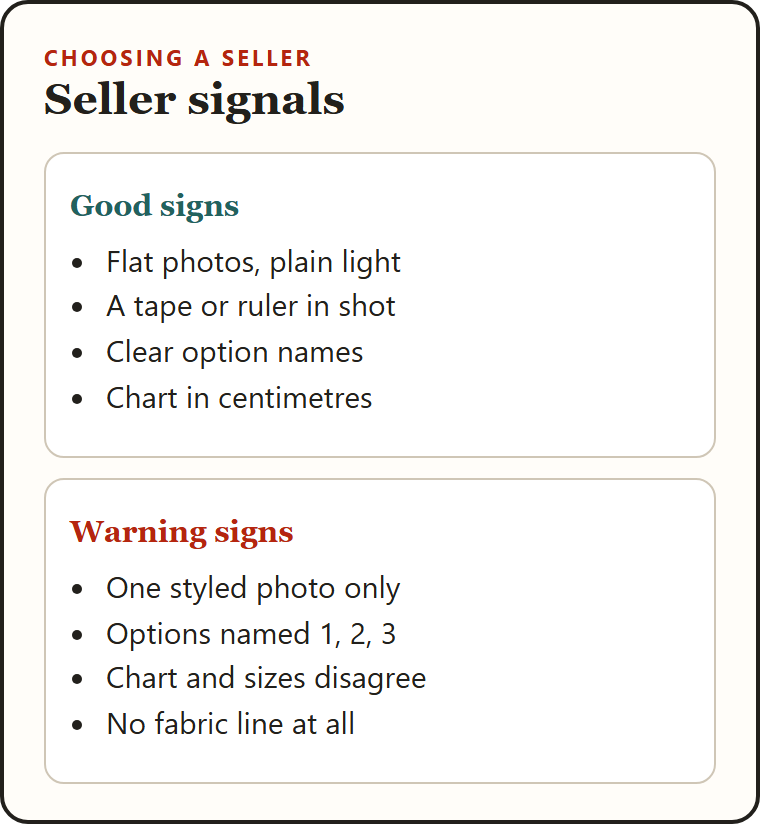
Choosing a seller is mostly about how they present facts. A seller worth buying from shows the item in plain light, gives a chart in centimetres, names options clearly and attaches a picture to each colour.
Some signals cost nothing to read: flat photos as well as model shots; a tape or ruler in at least one photo; option names that match the photos; a description that mentions fabric. Warning signs are just as visible: only one styled photo, options named 1, 2, 3 with no pictures, or a chart that does not match the sizes on offer.
Through an agent you can also ask the seller a question before buying. A clear answer about a measurement is a good sign in itself, and the answer belongs on your want list.
Sixty seconds before you pay
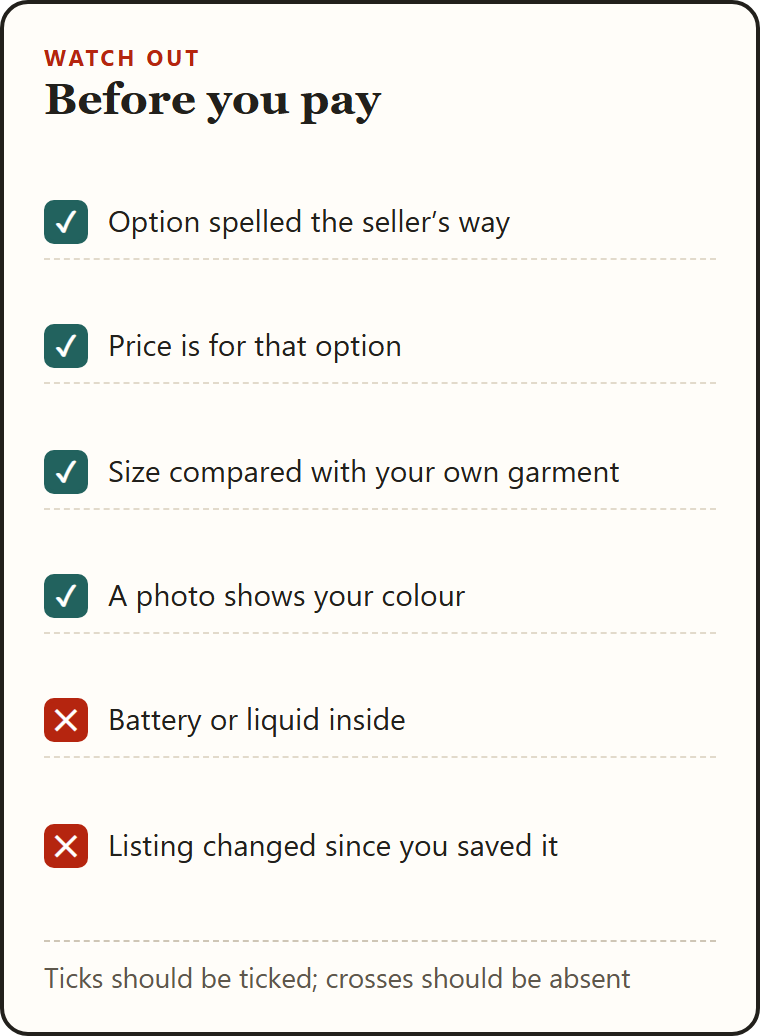
Most avoidable mistakes happen in the minute before payment. Before you pay, and before you send a find to the agent, run through a short list.
Is the option in your note spelled the way the seller spells it? Is the price you expect the price of that option? Have you checked the size against a garment of your own? Does at least one photo show your colour? Is the item something that limits shipping lines, such as a battery or a liquid?
Also watch for listings that change. Sellers sometimes rename a listing, swap its photos or reuse it for a different item. If the listing looks different from the day you saved it, start the five knowns again.
And check the category. When we paged through the catalog on 20 October 2026, the electronics category held a listing titled 网格黑色T恤 (black mesh T-shirt) and the bags category held a short-sleeved top. Trust the photo and the listing over the category name.